Rave Generation Sonic Spread — Free Download
Sonic Spread is a stereo utility plugin for detailed control over stereo imaging, delay-based width, and spatial effects, including Haas and Duophonic emulation, designed for music producers and sound designers.
Purpose and Core Concepts
Sonic Spread by Rave Generation is a stereo utility plugin designed to give audio professionals precise control over stereo imaging and delay-based spatial effects. It serves sound designers, music producers, and audio engineers seeking to add width, depth, and dimensionality to their mixes.
Beyond the Haas effect, Sonic Spread includes tools for emulating the Duophonic effect, originally developed at Capitol Records in the 1960s. This process splits a mono signal into two channels, applies a slight delay to one, and shapes the sound with filters.
Key Capabilities and Controls
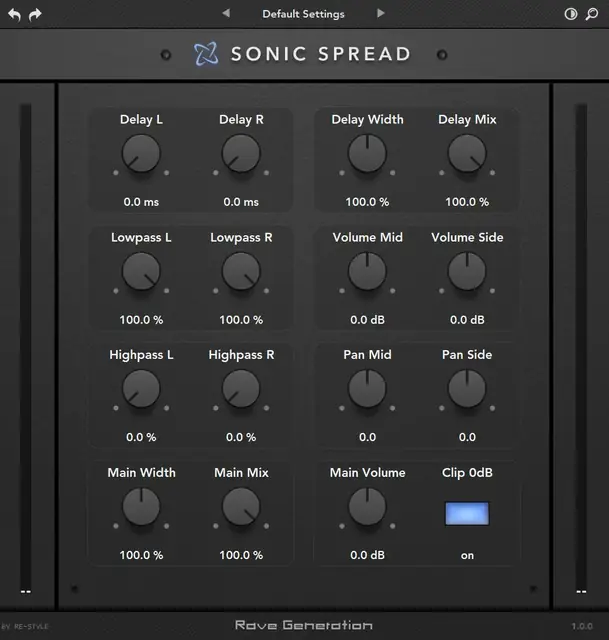
The plugin offers a comprehensive set of controls for shaping the stereo field. Users can independently adjust the delay time for the left and right channels, enabling precise control over the width and spatial position of the audio. Dedicated stereo width controls allow for fine-tuning the balance between mid and side content, letting you widen or narrow the stereo image to suit the material.
Frequency shaping is handled through high-pass and low-pass filters available on both left and right channels, giving you detailed tonal control over the processed signal. Volume and pan adjustments are also provided separately for mid and side channels, allowing you to balance the stereo field and place elements precisely in the panorama.
Workflow and Practical Applications
In practice, Sonic Spread can be used for subtle stereo enhancement or bold spatial effects. For a mono source, the Duophonic capability can simulate a stereo image by desynchronizing the two channels and applying frequency-specific filtering, then enhancing the result with external reverb or echo. This is useful for reviving vintage recordings or adding width to modern productions.
For stereo sources, the independent delay and width controls let you adjust the perceived space without compromising mono compatibility when used judiciously. The built-in clipping protection, which includes soft and hard clipping mechanisms to prevent peaks above 0 dB, ensures the output remains clean and distortion-free across all settings, making it a reliable tool for mixing and mastering stages.
Feature Summary and Best Use Cases
Sonic Spread is a versatile stereo utility that excels in applications requiring precise spatial control. Its combination of Haas effect, Duophonic emulation, and mid/side processing makes it suitable for both creative sound design and technical mixing tasks. The plugin is not a reverb or echo unit itself; rather, it is designed to work in conjunction with such effects to build larger spatial images.
When using the Duophonic effect, note that the expansion to full stereo width often benefits from additional reverb or stereo echo, as the source material may sound unnatural without it. The plugin’s interface is straightforward, with all key parameters accessible, but it does not include presets or built-in EQ beyond the basic filters. It is a focused tool for stereo imaging, not a multi-effect processor.
Key features
- Independent delay adjustment for left and right channels to enhance stereo width
- Stereo width control with separate mid and side adjustments
- High-pass and low-pass filters on each channel for frequency shaping
- Separate volume and pan controls for mid and side signals
- Dry/wet mix control for blending processed and unprocessed audio
- Built-in soft and hard clipping protection to prevent output distortion
- Duophonic effect emulation for creating stereo from mono sources
Best for
Sonic Spread is best for music producers and sound designers seeking detailed control over stereo width, Haas effect, and Duophonic-style width from mono sources. It suits mixing and mastering tasks requiring precise mid/side adjustment and clean output, especially when combined with reverb or echo for expanded spatial depth.