BOOM Library DeBird — Free Download
DeBird is a deep-learning audio tool that automatically detects and removes bird sounds from recordings, simplifying clean-up with a fast, drag-and-drop workflow.
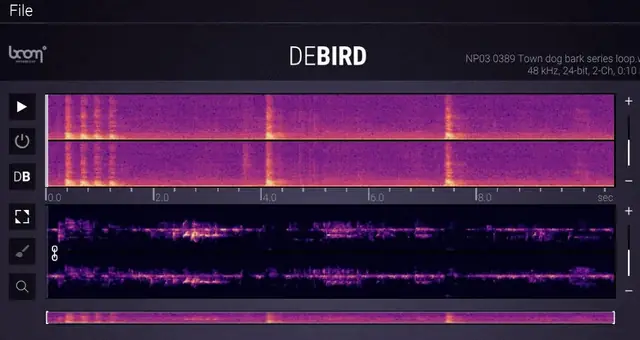
Purpose and Operation
DeBird tackles a common post-production annoyance: unwanted bird songs in otherwise clean recordings. While birds are welcome in nature ambiences, they become a problem in dialogue, foley, or music takes. The tool uses deep learning to automatically identify and remove bird noises, aiming to save editors hours of manual cleaning. It is designed for speed and simplicity, reducing tedious tasks to a few quick steps.
The workflow is straightforward: you drag an audio file into DeBird, and the software analyzes it. Once processed, the cleaned audio is ready for playback, and the removed bird sounds are visually indicated in a spectrum display. Exporting the cleaned file completes the job. The tool is non-destructive, preserving your original source file, and the machine learning model is said to improve over time.
Key Capabilities
DeBird’s central feature is one-click removal of bird noises, but it also offers flexibility. You can exclude specific sounds from removal by marking them with a boundary box or brush, preserving wanted elements like a bird call that should stay. This control ensures the tool works not just as a blanket filter but as a precise cleaning instrument.
For reverse use, DeBird allows you to solo and export the extracted bird sounds. This means you can isolate bird vocals for creative sound design or to create nature ambience layers. The processing is described as fast, and the algorithm aims to remove only bird frequencies, leaving the desired audio intact. The interface includes a lower spectrum display to visualize what was removed.
Workflow Integration
DeBird is built for efficiency in post-production pipelines. Its drag-and-drop interface reduces the learning curve, allowing editors to integrate it quickly into their routine. The non-destructive nature means you can experiment without risking the original recording, a key advantage in professional settings.
The ability to fine-tune the removal via selection tools adds a layer of precision for tricky takes. For sound designers, the solo and export feature opens creative possibilities, such as layering processed bird sounds into new contexts. The tool’s speed is a major draw, turning what could be hours of manual editing into minutes or seconds.
Practical Applications
DeBird is ideal for dialogue editing, where bird noise can ruin a clean voice track. It also serves podcasters and audiobook producers who record outdoors and need to eliminate background chirps. Indie filmmakers shooting on location will find it invaluable for cleaning production sound.
For sound effects editors, DeBird can clean nature recordings that are meant for purposes other than ambience, or it can be used to extract bird sounds for reuse. Post houses handling large volumes of material will appreciate the expedited workflow. The tool’s simplicity means even those new to audio processing can achieve professional results.
Key features
- One-click removal of bird noises from audio
- Deep learning algorithm for precise detection
- Drag-and-drop interface for fast processing
- Exclusion tools to preserve wanted sounds
- Solo and export of extracted bird sounds
- Non-destructive processing, original file preserved
- Continuous improvement via machine learning
Best for
Best for sound editors, dialogue cleaners, and content creators who need to quickly eliminate bird chirps from field recordings, dialogue takes, or music sessions, without compromising the integrity of the original audio. Its reverse solo feature also suits sound designers seeking isolated bird vocals or creative sound elements.