Xhun Audio FireBurn — Free Download
FireBurn is a procedural audio engine simulating fire and combustion physics in real time using a particle collision system. It generates sound without samples, offering automation-ready controls for music, film, TV, and live events.
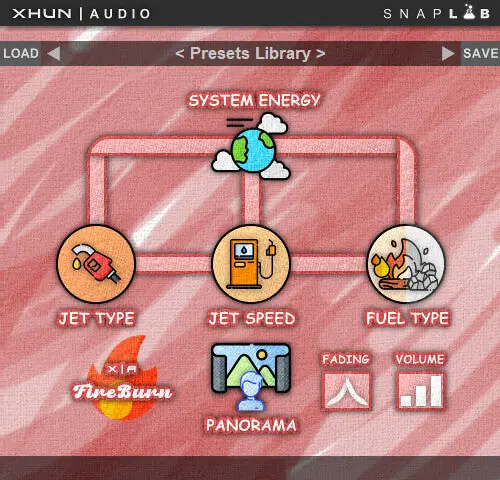
Purpose and Core Technology
FireBurn is a procedural audio simulation engine focused on realistic fire, flames, and turbine-like sounds. It replaces sample-based synthesis with a real-time particle collision simulation, which generates both the audible output and the physical behavior. This means every sound is unique and dynamic, not a static recording. The engine uses the Advanced Component Simulation approach for accuracy.
The engine processes all simulation elements at full 64-bit precision, which supports detailed audio rendering. It includes a stochastic engine that manages randomness, making each pass feel organic. The result is an immersive audio landscape that can range from subtle crackles to roaring jets. Because no samples are used, the system is flexible for creative and production needs.
Key Capabilities and Controls
FireBurn offers both manual control and full automation for the entire simulation. You can adjust parameters in real time to shape the fire’s intensity, texture, or spatial position. The built-in panorama control adds depth, allowing sounds to move across the stereo field. It also supports MIDI automation, so external controllers can drive the parameters.
A ready-to-use factory preset collection is included, giving you a quick start for common fire and combustion effects. The interface is available in multiple GUI resolutions to fit different screen sizes and workflows. Generating a complex effect can be as simple as pressing a single key, but deep editing is possible for advanced users.
Workflow and Applications
For sound designers, FireBurn can be automated over time to create evolving fire beds, from gentle campfire to explosive blazes. The particle collision engine responds to parameter changes instantly, so you can add movement or change the texture without editing samples. This makes it suitable for scoring, game audio, or installation work.
In live events, the engine’s real-time generation means it can react to visuals or performer actions. For film and TV, you can build custom fire sounds that match specific scenes, such as a sparks or a furnace. The lack of samples ensures that each take is different, which helps in creating unique soundtracks.
Practical Considerations
You should plan to spend time learning the engine’s parameters to get the most out of it. The stochastic nature means results can be surprising, so create automation curves carefully. For production, you might start with factory presets and then tweak them to fit your project.
The software is delivered as a digital license, and once activated it is non-returnable, so ensure it meets your needs. It is designed for high sample rates if your system supports them, but keep in mind that higher rates may increase CPU load, especially with 64-bit processing.
Key features
- Procedural combustion simulation with real-time particle collisions
- No sample playback—fully dynamic sound generation
- Full 64-bit processing for all simulation aspects
- Advanced Component Simulation (ACS) for accuracy
- Manual and fully automated parameter control
- MIDI automation support for external control
- Factory presets and multiple GUI resolutions
- Panorama control for immersive placement
Best for
Best for sound designers and composers seeking realistic fire or combustion effects without samples, in music, film, TV, live events, or interactive media, especially when dynamic, evolving sound is needed.