Klevgrand Baervaag — Free Download
Baervaag is a straightforward FM synthesizer with one carrier and one modulator, offering morphable waveforms, FM feedback, and hands-on controls. Includes over fifty presets, delay, and chorus effects.
Purpose and Core Design
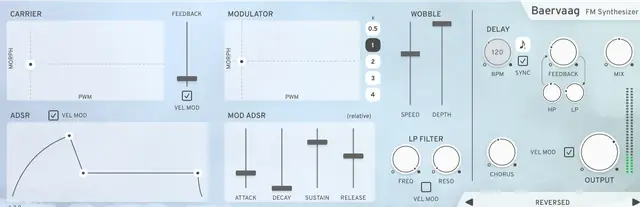
Baervaag is a virtual instrument focused on making FM synthesis approachable. It simplifies the classic FM architecture to a single carrier and a single modulator, stripping away the complexity often associated with this synthesis method. The main interface revolves around two XY pads, one for each oscillator, which allow you to shape the waveform continuously from a pure sine wave to a square wave, with pulse width modulation available along the other axis.
The instrument includes an FM feedback control for adding grit or tonal movement. A controllable wobble factor introduces analog-style unpredictability, which can make sounds feel more organic. The signal then passes through a master section featuring high-quality delay and chorus effects, plus an output level control.
Oscillators and Modulation
The carrier oscillator is controlled via an XY pad where the X-axis adjusts pulse width and the Y-axis morphs the wave shape. Its dedicated ADSR envelope shapes the amplitude, and the attack time can be made responsive to MIDI velocity for more expressive playing.
The modulator’s envelope is handled by a set of sliders labeled Relative ADSR. These are designed to work in relation to the carrier envelope: when all sliders are centered, the modulator envelope matches the carrier’s. Moving the sliders up or down makes the modulator envelope longer or shorter, allowing for time-varying timbres that evolve differently from the amplitude.
Effects and Sound Design Workflow
After the oscillators and envelopes, the signal runs through an FX and master section. This includes a high-quality delay effect and a high-quality chorus effect, both of which can be used to add space, width, and movement to the sound. The master output knob acts as a final level control.
A practical workflow starts with selecting one of the over fifty presets created by professional musicians, then tweaking the XY pads to alter the core tone. From there, you can adjust the envelopes to change the feel, dial in feedback or wobble for character, and finally sweeten the result with the built-in delay and chorus. This makes Baervaag useful for quickly sketching ideas or designing specific sounds from scratch.
Practical Applications and Limitations
Baervaag is well suited for many musical contexts. Its simplicity makes it ideal for producers who want FM tones—such as metallic bells, bass, or evolving pads—without deep programming. The velocity-sensitive attack and relative envelopes support expressive play, while the wobble factor can create subtle variations in long sustained notes. The included presets serve as a solid starting point for various genres, including electronic, pop, and soundtrack work.
The two-operator architecture is a deliberate limitation: it cannot produce the complex multi-operator sounds found in more advanced FM synths. However, the morphable waveforms, feedback, and effects extend its range considerably. For those new to FM or looking for a quick tool, Baervaag offers a focused and approachable alternative to more intimidating FM instruments.
Key features
- Single carrier and single modulator FM architecture
- Morphable wave shapes from sine to square with PWM on both oscillators
- Independent ADSR envelopes for carrier and modulator, with relative modulator envelope control
- Modulator frequency multiplier button and FM feedback
- Velocity-reactive attack time for the carrier envelope
- Adjustable wobble factor for analog-style instability
- Built-in high-quality delay and chorus effects
- Over fifty presets crafted by professional musicians
Best for
Musicians and producers seeking an easy-to-use FM synthesizer for creating basses, leads, pads, and bell-like tones. Its streamlined interface and expressive controls make it a great choice for live performance and quick sound design, especially for those new to FM synthesis or who prefer a hands-on, visual approach.