Modartt Pianoteq Instrument Pack: Celeste — Free Download
A collection of four physically modeled percussion instruments for Pianoteq: Celesta, Glockenspiel, Toy Piano, and Kalimba, offering expressive control and authentic timbres.
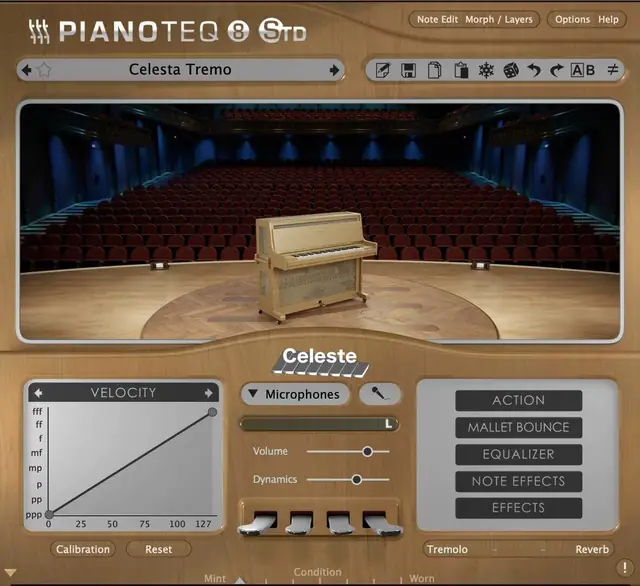
Instrument Overview
This pack brings together four distinct pitched percussion instruments, each modeled after specific acoustic references. The Celesta replicates a modern five-octave German instrument, known for its soft, subtle tone produced by felt hammers striking metal plates. The Glockenspiel, based on a modern French model and extended to four octaves, offers a brilliant, high-pitched sound from hard mallets on metal plates.
The Toy Piano, modeled after a two-octave Michelsonne and extended to four octaves, produces a unique timbre closer to celesta or glockenspiel than a standard piano. The Kalimba, a handheld African instrument with metal tines on a wooden board, has a default range of twenty notes but can be extended to eighty-eight. All instruments benefit from Pianoteq’s physical modeling, providing realistic response and articulation.
Key Capabilities
The physical modeling approach allows for continuous variation and expressiveness beyond sample libraries. A notable feature is the humanization of the strike point, which introduces subtle variations in where and how each note is struck. This is particularly valuable for the Glockenspiel, where real players rarely hit the exact same spot twice, adding a natural, organic quality to performances.
Traditional piano features can be integrated, including damping, a sustain pedal, and a soft pedal, giving performers control over sustain and timbre. These capabilities make the instruments versatile for both realistic emulation and creative sound design. The models respond to velocity and pedal input in a musically meaningful way, allowing for nuanced phrasing and dynamics.
Workflow and Integration
Within Pianoteq, these instruments can be loaded and played like any virtual instrument, responding to MIDI input and offering editable parameters for fine-tuning. The extended ranges enable playing beyond the physical limits of the original instruments, opening new melodic possibilities. The humanization feature can be adjusted to taste, from subtle to pronounced, depending on the desired realism.
The instruments are suited for both live performance and studio production, providing a reliable and lightweight alternative to bulky acoustic instruments. They can be layered with other sounds or used solo to create delicate textures. Integration with piano features such as pedals works seamlessly, allowing for expressive control similar to playing a grand piano.
Practical Applications
These instruments are ideal for adding color to orchestral compositions, film scores, and contemporary music. The Celesta evokes the magical atmosphere of Tchaikovsky’s Nutcracker, while the Glockenspiel can recreate Mozartian brightness. The Toy Piano has a charming, quirky character, as heard in the Amélie soundtrack, and the Kalimba adds an earthy, resonant voice to world music or ambient pieces.
Composers and producers seeking distinctive percussive textures will find these tools valuable. The extended ranges allow for solo melodies or supporting harmonies that transcend the original limitations. With editable modeling parameters, users can shape the sound to fit specific mixes or artistic visions, making the pack a flexible addition to any virtual instrument collection.
Key features
- Four physically modeled instruments: Celesta, Glockenspiel, Toy Piano, Kalimba
- Based on specific acoustic references (e.g., German Celesta, French Glockenspiel)
- Extended ranges on Glockenspiel, Toy Piano, and optional Kalimba extension
- Humanization of strike point for expressive variation
- Integration of piano features: damping, sustain pedal, soft pedal
- Real-time MIDI response and editable physical parameters
Best for
This pack is best for composers and sound designers seeking realistic, expressive pitched percussion for film scores, classical music, or original compositions. It excels at adding delicate, bell-like timbres or quirky character, while the physical modeling allows for unique tonal shaping and performance nuance beyond sample-based alternatives.