Moog Moogerfooger MF-102S Ring Modulator — Free Download
A faithful software recreation of the Moog MF-102 Ring Modulator pedal, expanding on the original with stereo capability, extended modulation, CV interconnects, and preset storage for modern music production.
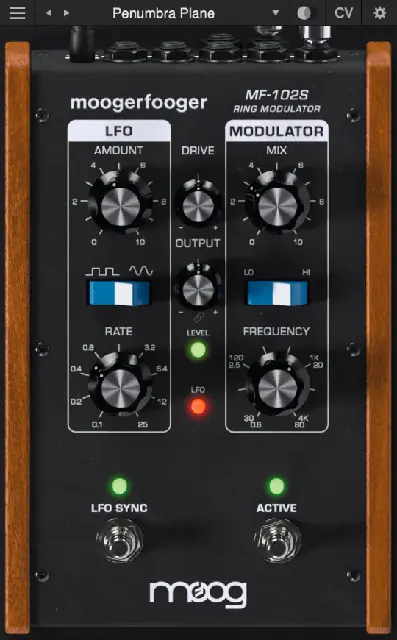
Core Function and Sound
The MF-102S Ring Modulator is a software emulation of the classic Moog pedal, delivering the same retro-futuristic timbres that defined the original hardware. It combines a ring modulator, a voltage-controlled carrier oscillator, and a dual-waveform low-frequency oscillator (LFO) into a single, versatile plug-in. This design lets you process any audio source—guitar, voice, or synth—with rich, metallic, and inharmonic textures.
The plug-in faithfully captures the organic interaction of the hardware’s parameters, allowing for expressive and musical modulation. Built with the modern creator in mind, it supports multiple instances and offers preset management, making it easy to recall complex settings within any session. The intuitive layout keeps the experimental nature of the original accessible while adding new creative options.
Expanded Stereo Capabilities
A significant expansion over the hardware is the stereo functionality. The carrier type can be switched between a mono oscillator, as found on the original, and a stereo oscillator. This stereo mode provides out-of-phase carrier signals, with panning and reverse controls to craft wide, animated soundscapes. This makes the MF-102S a powerful tool for creating spatial effects that move beyond the mono output of the original pedal.
This added stereo dimension benefits both mixing and sound design. You can create everything from subtle width enhancements to dramatic, rotating textures that fill the stereo field. The reverse option allows for unique phase relationships between the left and right channels, offering fresh possibilities for creative audio manipulation and immersive production techniques.
Modulation and Control Flexibility
The MF-102S provides flexible modulation options, including a polarity switch for the LFO that can be set to bipolar or unipolar operation. You also have dedicated control voltage (CV) inputs for carrier frequency, LFO rate, LFO amount, and mix. An independent carrier input is available, and you can attenuate or soften each modulation source for precise, musical results.
These controls allow for complex, evolving modulation patterns that can be automated or driven by external sources. Whether you need slow, sweeping filter-like effects or rapid, rhythmic shifts, the ability to shape the modulation depth and polarity gives you detailed command over the final sound. This makes the plug-in suitable for both subtle coloration and extreme sonic experimentation.
Workflow and Creative Applications
In practice, the MF-102S shines in a variety of musical contexts. Guitarists can use it to add clangorous, metallic overtones to riffs or create eerie, sci-fi textures for ambient passages. Vocal producers might apply it to generate robotic or bell-like timbres, while electronic musicians can use it to mutate synth pads or drum loops into entirely new, otherworldly sounds.
The CV interconnectivity and expandable features also make it a valuable component in a modular-style workflow. You can route the LFO or carrier to modulate other parameters, creating integrated, living patches that respond dynamically to your input. The ability to run multiple instances lets you create complex chains or individual effects for different elements, bringing the classic Moog character to any digital production environment.
Key features
- Faithful recreation of the Moog MF-102 hardware ring modulator
- Stereo carrier oscillator with panning and reverse options
- Bipolar or unipolar LFO polarity selection
- CV inputs for carrier, LFO rate, LFO amount, and mix
- Independent carrier input with attenuation control
- Supports multiple instances and preset storage
Best for
Musicians and producers seeking authentic ring modulation effects with enhanced stereo and modulation flexibility. Ideal for guitar, vocal, or synth processing, adding metallic timbres and animated spatial textures to any mix, from subtle movement to extreme sonic manipulation.