T-RackS Space Delay — Free Download
T-RackS Space Delay emulates the iconic Roland RE-201 Space Echo using advanced convolution and physical modeling. It captures the warm, organic tape echo and spring reverb character with flexible controls for authentic sound shaping.
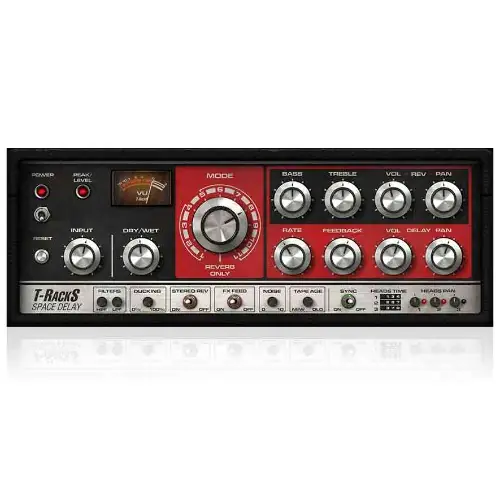
Authentic Tape Echo Emulation
T-RackS Space Delay recreates the Roland RE-201 Space Echo, a legendary delay unit known for its warm, rich sonic signature. The development process began with an original unit meticulously restored to factory spec, and every component was analyzed and measured to build a precise physical model. This includes preamps and playback heads, ensuring detailed reproduction of the tape-based system.
The physical modeling is paired with a dynamic convolution engine that captures subtle details like the spring reverb. This dual approach delivers stunning fidelity, building on IK Multimedia’s Tape Machine Collection techniques. The result is an effect that preserves the organic musicality of the original, offering a faithful emulation for producers seeking classic tape echo textures.
Advanced Modeling Technology
The plugin uses a sophisticated combination of dynamic convolution and physical modeling to achieve its authentic sound. The physical model covers the entire signal path from input preamps to the playback heads, while the convolution engine handles complex elements like the internal spring reverb. This approach goes beyond simple sampling, providing interactive response to playing dynamics.
IK Multimedia spent two years developing their acclaimed Tape Machine Collection, and Space Delay advances that research further. The updated engine captures the interdependent behaviors of tape-based systems, including saturation, wow and flutter, and echo repeats. This results in a delay that responds naturally to input level and control changes, making it suitable for both subtle enhancements and pronounced effect.
Flexible Sound Shaping Controls
Space Delay provides a range of controls that allow users to shape the organic sound of the classic delay. Parameters likely include echo volume, repeat rate, intensity, and mode selection, mirroring the original unit’s panel. These controls enable adjustment of modulation and feedback to create anything from a gentle slapback to cavernous echoes with distinct tape character.
The interface is designed for intuitive operation, letting musicians and engineers dial in the desired effect without guesswork. The physical modeling ensures that control changes interact smoothly, as on the hardware, offering real-time tweakability. This makes the plugin suitable for creative sound design in the studio or as an insert effect during mixing, providing authentic vintage tone.
Workflow and Applications
In a mixing workflow, T-RackS Space Delay can be inserted on individual tracks or buses to add depth and dimension. Its character works well on vocals, guitars, and synths, introducing a warm, retro atmosphere. The spring reverb element extends its versatility, allowing it to serve both as a delay and reverb unit for atmospheric effects.
For productions seeking a vintage tape sound, the plugin offers a precise alternative to hardware maintenance. It can be used subtly to enrich a signal or prominently for dramatic echo trails. The fidelity of the modeling ensures that it integrates with modern tracks without sounding sterile, making it a valuable tool for genres like indie rock, lo-fi, or ambient music.
Key features
- Emulates the iconic Roland RE-201 Space Echo
- Uses dynamic convolution and physical modeling
- Based on a meticulously restored original unit
- Captures spring reverb and playback head behavior
- Provides flexible controls for echo and modulation
- Delivers high fidelity and authentic tape sound
Best for
T-RackS Space Delay is ideal for music producers and mixing engineers seeking authentic tape echo textures. It excels at adding warm, organic delay to vocals, guitars, and synths, fitting genres that favor vintage character such as indie, lo-fi, and ambient, where classic multi-tap echoes enhance spatial depth.