Wave Arts MR Noise 6 — Free Download
MR Noise 6 is a frequency-domain broadband noise reduction processor known for its easy workflow and transparent results, featuring auto dynamics and a comprehensive visual display.
Purpose and Workflow
MR Noise 6 is designed to remove steady background noise such as hiss, hum, or air conditioning from audio recordings. Its primary goal is to provide great-sounding noise reduction with minimal user effort, making it suitable for both quick fixes and detailed restoration work.
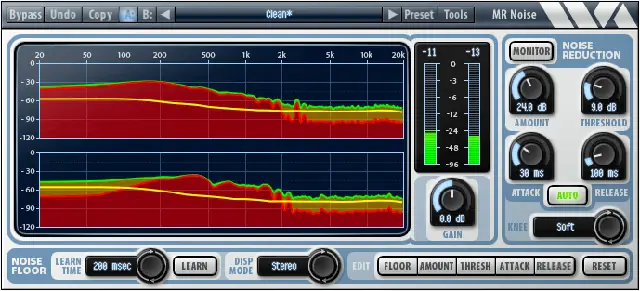
By default, the Learn parameter is enabled, so when you hit play, MR Noise captures the noise spectrum and begins reduction. The default settings are tuned to work well for most material, allowing you to simply press play and hear the noise disappear. For more control, you can adjust the Amount parameter to dial in the desired level of reduction, making the initial workflow extremely straightforward.
Key Capabilities
One standout feature is Auto Dynamics mode, which automatically adjusts the attack and release times based on the amount of transients in the input signal. This helps keep sharp transients, like drum hits or plosives, intact while avoiding artifacts such as pumping or smearing that can occur with other noise reduction methods. The result is cleaner audio with more natural dynamics.
The user interface includes a frequency response display that shows the input signal, the learned noise floor, and the output signal simultaneously. This lets you see exactly which frequencies are being reduced. Additionally, a monitor feature lets you audition the noise that is being removed, with a separate volume control, so you can verify that the processor is targeting the right content without affecting the desired audio.
Fine-Tuning and Flexibility
For users who need more precision, MR Noise 6 allows the noise floor and all reduction parameters to be edited as a function of frequency. You can drag control points directly on the frequency response display to shape the reduction curve. This is useful for handling noise that varies across the spectrum, such as a hum that is stronger at certain frequencies or hiss that tapers off at the top end.
This manual editing capability gives you full control over the processor, allowing you to preserve specific frequencies that are important to the signal while removing noise elsewhere. Whether you are working on a voice-over with a low-frequency rumble or a music track with high-frequency tape hiss, you can tailor the reduction to match the unique characteristics of your recording.
Practical Applications
MR Noise 6 is well suited for post-production tasks such as cleaning up dialogue, vocals, or instrument recordings that have been captured in less-than-ideal environments. It can also be used in live situations, thanks to its low latency and fast noise floor learning time. The quick learning means you do not need to loop the noise section; it can capture the profile almost immediately and start processing in real time.
The comprehensive display and monitor feature make it easy to set up and trust the processor, even in critical listening conditions. You can use it in a compatible host that offers latency compensation to ensure the processed signal aligns perfectly with other tracks. With support for high sampling rates and mono or stereo sources, it is flexible enough for a wide range of audio projects, from podcasts to music production.
Key features
- Frequency spectrum based noise reduction
- Low latency for live use
- Fast noise floor learning
- Auto dynamics mode for transient preservation
- Monitor feature to hear removed noise
- Comprehensive spectrum display
- Manually editable noise floor and parameters
Best for
MR Noise 6 is best for reducing steady broadband noise in dialogue, vocals, and instruments, especially when you need a quick, transparent solution with minimal artifacts. It is also ideal for live or fast-paced workflows thanks to its low latency and automatic learning, and for detailed restoration projects requiring frequency-specific adjustments.