Pianoteq 9 Standard — Free Download
Pianoteq 9 Standard is a physically modeled piano virtual instrument with three included instrument packs, advanced sound-shaping tools, and a realistic 3D microphone placement interface for expressive, sample-free performance.
Purpose
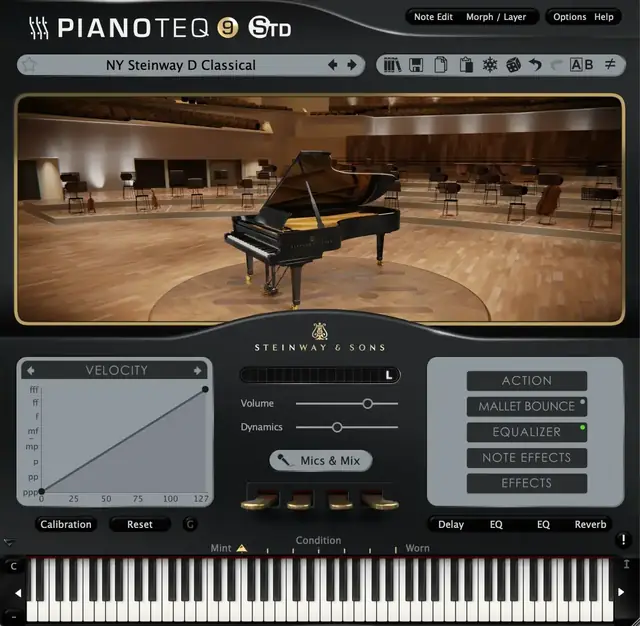
Pianoteq 9 Standard is a virtual instrument designed to replicate the playability and complex behavior of acoustic pianos through physical modeling rather than samples. Because no samples are stored, the software has a tiny file size and runs efficiently on a wide range of computers, including some ARM boards like the Raspberry Pi. It operates in standalone mode or as a plug-in in VST, AAX, and AudioUnits hosts.
This version focuses on realism and expression, featuring an enhanced soundboard model for improved stereo and spatial perception, meticulously revoiced grand pianos, and expanded presets like Sombre for cinematic depth and Felt for historical instruments. It includes three instrument packs chosen by the user, and collaborations with major manufacturers ensure authentic concert grand sounds.
Key Capabilities
The core capability is adjusting physical parameters to shape the sound in ways impossible with sample libraries. Users can modify unison width, hammer hardness, and string length, enabling creative changes like transforming a mini grand into an imaginary giant. The morphing feature allows merging multiple instrument models to create unique, organic sounds.
For spatial control, up to eight virtual microphones can be placed in a redesigned 3D interface, with fifteen modeled microphone types available. A mixer combines microphones into multiple output channels with adjustable level and delay. In binaural mode, a head model simulates sound for headphone listening, and the head can be rotated and resized for a personalized experience.
Workflow
Users start by selecting their three preferred instrument packs and then choose presets from the FXP Corner, which includes creations from other Standard and PRO users, ensuring identical sound across versions. The 3D microphone panel allows for intuitive placement, similar to recording a real piano, so users can quickly adjust the color and presence of the sound.
Advanced tuning tools enable note-per-note edits of volume, detune, and attack envelope, perfect for customizing individual keys. The streamlined mixer facilitates routing microphones to different outputs, while the built-in EQ, velocity curve, and reverb unit provide additional shaping. Loading external reverb impulses expands the acoustic environment possibilities.
Practical Applications
Pianoteq 9 Standard suits composers and producers who need instant, expressive piano sounds without loading large sample libraries. Its small footprint makes it ideal for laptop-based music production, especially for live performances or on-location sessions. The morphing and parameter tweaks open doors for sound designers seeking unconventional piano timbres.
The binaural mode is perfect for headphone listening, offering immersive practice or mixing. With presets from the FXP Corner, users can explore a vast library of styles. However, note that Standard includes only three packs; users may need to purchase additional ones. The software is available for Windows, macOS, Linux, and some ARM boards, and can be used standalone or as a plug-in.
Key features
- Physically modeled pianos with no samples, tiny file size
- Three included instrument packs of user’s choice
- Morph and layer multiple instrument models
- Up to eight virtual microphones in 3D space with fifteen modeled types
- Adjustable physical parameters like unison width, hammer hardness, string length
- Built-in EQ, velocity curve, reverb unit, and external impulse loading
- Note-per-note edit for volume, detune, and attack envelope
Best for
Pianoteq 9 Standard is best for keyboardists, composers, and sound designers who want a highly expressive, physically modeled piano with deep sound-shaping tools, ideal for laptop-based production, live performance, and creative experimentation.