Leapwing Audio StageOne 2 — Free Download
StageOne 2 is a stereo field processor that widens stereo audio, adds perceived depth, and creates stereo images from mono sources, with phase-safe algorithms and a 3-band crossovers.
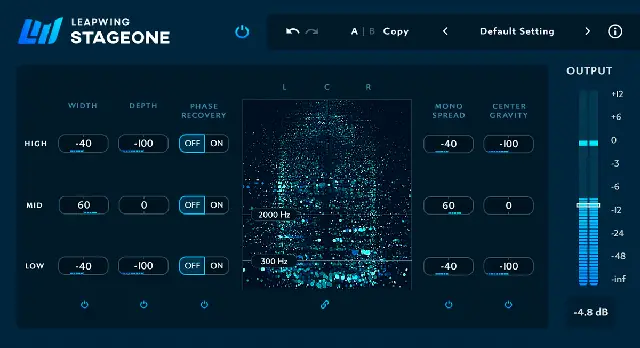
Purpose and Core Function
StageOne 2 is a dedicated stereo field processor designed to shape the spatial characteristics of audio. It addresses three primary tasks: widening existing stereo tracks, adding a sense of depth or ambience, and transforming mono signals into stereo images that integrate better within a mix.
The processor works by manipulating how listeners perceive off-center content, leaving the phantom center untouched. This approach allows for a wider, richer panorama without compromising the integrity of centered elements like vocals or bass. Additionally, it can generate directionally optimized reflections to psychoacoustically adjust the position of audio within the sound field, giving you the ability to place elements precisely in the stereo spectrum.
Key Capabilities
StageOne 2 introduces three-band control over the stereo soundstage, with separate low, mid, and high bands and adjustable crossover frequencies. This allows you to apply width, depth, or mono spread to specific frequency ranges, giving you surgical control over the stereo image. For example, you can widen the high frequencies for airiness while keeping the low end tightly centered.
The updated version includes a unique visualizer that displays amplitude, frequency, and perceived stereo width for both the input and output signals. This real-time feedback helps you understand and dial in the exact spatial effect you’re applying. Another significant addition is the Phase Recovery algorithm, which intelligently identifies and re-aligns out-of-phase components. This prevents information loss when summing to mono, ensuring that even problematic source material remains compatible.
Workflow and Interface
The interface is designed to be intuitive, allowing you to achieve results faster than with traditional techniques. The three-band controls and crossover points are adjustable directly, while the visualizer provides immediate confirmation of your adjustments. The workflow is straightforward: load the plugin, adjust the width, depth, and mono spread controls, and refine using the visualizer and phase recovery.
Because the algorithm is phase-coherent, you can use it confidently on a wider range of sources than conventional stereo tools. The processor is suitable for both mixing and mastering scenarios, where precision and mono compatibility are critical. Whether you’re working on individual tracks, buses, or the master, StageOne 2 offers a reliable way to enhance spatial perception without unintended artifacts.
Practical Applications
StageOne 2 excels in several practical applications. For mixing, you can use it to widen stereo elements like synths, guitars, or background vocals, giving them more presence in the mix. It also aids in adding perceived depth to reverb returns or ambience tracks, helping to position elements front-to-back in the soundstage.
For mono sources, such as a single microphone recording or an old sample, StageOne 2 can create a rich stereo image that integrates better with stereo material. This is especially useful when balancing mono and stereo elements within a mix. The Phase Recovery feature is beneficial when working with sources that have phase issues, restoring them to mono-compatible states. Overall, the plugin is a versatile tool for sound designers and engineers seeking to expand their spatial toolkit.
Key features
- Three-band controls with adjustable crossover frequencies
- Unique visualizer showing amplitude, frequency, and perceived stereo width
- Phase Recovery algorithm re-aligns out-of-phase components
- Widens stereo audio while leaving phantom center untouched
- Adds perceived depth using directionally optimized reflections
- Creates stereo images from mono sources without mono-compatibility issues
Best for
StageOne 2 is best for audio engineers and producers who need to widen stereo mixes, add depth to individual tracks or buses, or convert mono sources to stereo while maintaining mono compatibility. Its phase-safe algorithm and three-band control make it suitable for mixing and mastering, especially when precise spatial adjustment is required.