D16 Spacerek — Free Download
Spacerek is a hybrid reverb combining modeled early reflections with a dynamic delay network, offering diverse room models, flexible stereo control, and intuitive frequency shaping.
Purpose and Core Technology
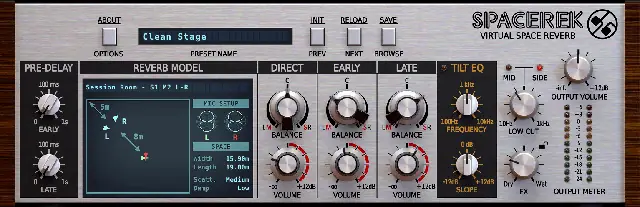
Spacerek is designed to deliver realistic reverb for music production and sound design by merging two complementary synthesis methods. Its Virtual Space Reverb engine models early reflections from a variety of real-world spaces, capturing both the room’s acoustics and the placement of virtual microphones and speakers. Late reflections are generated by a dynamic delay network, which responds to input and blends seamlessly with the early reflections to create a natural-sounding tail.
This hybrid algorithm balances quality and CPU efficiency, allowing for complex spatial simulations without excessive processing demands. Each of the included reverb models predefines the stereo operation (left-right or mid-side) and the speaker/microphone setup, simplifying the process of achieving immersive depth. Independent pre-delay controls for early and late reflections offer precise timing adjustments, with fine resolution available for detailed tweaking.
Key Capabilities and Controls
The interface revolves around a three-channel mixer for Direct, Early, and Late reflection signals, giving you individual volume and balance controls for each component. Stereo width and positioning are adjusted according to the model’s selected mode, whether left-right or mid-side, enabling flexible spatial shaping.
Spacerek includes a tag-based preset browser for organizing and recalling settings, a resizable GUI for adapting to various screen sizes, and MIDI Learn for assigning hardware controllers to parameters. These features streamline workflow, allowing quick experimentation with different room types and adjustments.
Workflow and Usage
In a mixing session, you can start by selecting one of the many reverb models—ranging from booths and chambers to halls, tunnels, and towers—each with multiple mic and speaker setups. Adjust the early and late reflection pre-delays to align the reverb with the source material’s rhythm, then use the mixer to set the level of dry signal, early reflections, and late reflections. This allows you to create anything from subtle ambience to prominent, spacious effects.
The Tilt EQ and Low Cut filter serve as finishing tools, letting you shape the tail to fit the mix. For instance, a high-pass filter on the side signal can reduce muddiness in mid/side processing. With MIDI Learn, you can automate parameter changes live, making it suitable for performances or evolving sound design textures.
Practical Applications and Integration
Spacerek excels in music production, especially for genres that benefit from realistic room simulations, such as orchestral, ambient, or rock. It can add depth to vocals, drums, or instruments, and the variety of room models supports creative choices like placing a guitar solo in a chapel or a synth pad in a tunnel. In sound design, the reverb can transform dry effects into immersive spatial elements, and the mid-side capabilities are useful for widening or narrowing stereo fields.
For producers working with hardware or external controllers, MIDI Learn ensures hands-on tweaking of reverb parameters does not require navigating the GUI. The resizable interface helps fit the plugin into any screen layout, and the preset browser accelerates session recall. Spacerek integrates into any professional audio host as a standard effect plugin, provided the host supports the plugin format (not specified).
Key features
- Hybrid reverb algorithm: Virtual Space Reverb for early reflections, Dynamic Delay Network for late reflections
- 114 reverb models with multiple mic and speaker configurations per room
- Three-channel mixer for Direct, Early, and Late signals
- Independent pre-delay controls for early and late reflections
- Tilt EQ and Low Cut filter with independent mid/side activation
- Tag-based preset browser, resizable GUI, MIDI Learn support
Best for
Spacerek is best for mixing engineers and sound designers seeking realistic room simulation with flexible control over early and late reflections, stereo width, and tone shaping, suitable for a wide range of genres from acoustics to electronic music.