TC Electronic LM6 - 5.1 Surround Loudness Meter — Free Download
TC Electronic LM6 is an audio loudness meter plug-in for mono, stereo, and 5.1 productions, offering radar visualization, true-peak monitoring, and detailed logging for broadcast, film, and streaming. It works with Pro Tools and major DAWs.
Purpose and Standards Compliance
The LM6 loudness meter is designed for engineers working in broadcast, film, and streaming, where meeting loudness standards is critical. It provides detailed analysis for mono, stereo, and surround sound productions, ensuring audio meets required specifications. The plug-in supports AAX, VST, and Audio Units formats, so it integrates with Pro Tools and virtually any major DAW.
For surround work, the LM6 offers a user-configurable display order for channels, making it adaptable to different speaker layouts or post-production workflows. A desaturated view mode is included for film professionals who need to keep focus on the visuals without distractions from bright interface colors. These features allow engineers to monitor loudness accurately while maintaining efficiency and visual clarity during long sessions.
Radar Visualization and True-Peak Monitoring
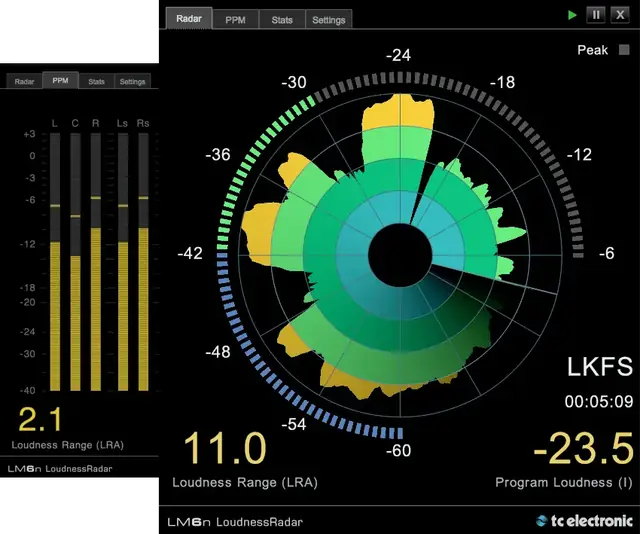
The centerpiece of the LM6 is the Loudness Radar display, which gives a complete landscape of the audio’s loudness at a glance. This radar view helps engineers see how loudness varies over time across channels, making it easier to identify issues.
True-peak monitoring detects hidden peaks that occur between samples, which is important for preventing distortion in digital formats. This precise reading lets engineers normalize audio confidently without risking quality. Additionally, a detailed statistics page provides key parameters such as program loudness, maximum short-term loudness, loudness range, true-peak max, a sliding loudness window, and peak-to-loudness ratio. This data supports informed decisions during mixing and mastering.
Workflow and Offline Measurement
The LM6 includes offline measurement for Pro Tools, allowing engineers to analyze audio files faster than real time. This speeds up the process of checking loudness before delivery, as you can scan entire sessions without waiting for playback. The plug-in also offers comprehensive logging capabilities that run continuously, tracking loudness data over extended periods.
In the DAW, the LM6 fits into your existing workflow as a plug-in, so you can insert it on master busses or individual tracks. The detailed statistics page updates in real time, providing ongoing feedback while you adjust levels. For streaming and broadcast deliverables, this tool helps ensure that your final mix meets the required loudness targets, reducing the risk of rejection by platforms or broadcasters.
Practical Applications and Limitations
The LM6 is suitable for music production, post-production for film and TV, and any project requiring loudness normalization. It is particularly valuable for 5.1 surround mixes, where traditional stereo meters fall short. Engineers can use it to compare loudness between different parts of a project, such as dialogue, music, and effects, ensuring a balanced mix.
The plug-in requires a compatible host DAW supporting AAX, VST, or Audio Units; it is not a standalone application. The offline measurement feature is listed only for Pro Tools, so other DAW users may need to rely on real-time monitoring. While the LM6 covers current loudness standards, users should verify that their specific delivery specifications match the plug-in’s capabilities.
Key features
- Loudness Radar display with normal and large sizes
- True-peak meter to catch inter-sample peaks
- Detailed statistics: program loudness, short-term max, LRA, true peak, sliding window, PLR
- Offline measurement in Pro Tools for faster-than-real-time analysis
- User-configurable surround channel order
- Desaturated view for film work
- Continuous logging for long-duration monitoring
Best for
Ideal for broadcast, film, and streaming engineers who need precise loudness compliance, especially when working in 5.1 surround. It suits mixing, mastering, and QC workflows in Pro Tools or other major DAWs, providing fast, visual analysis and logging to ensure final deliverables meet critical loudness standards.