Faber Acoustical SignalScope XM Tool Set - Basic — Free Download
SignalScope XM is a Mac-based dynamic signal analysis and acoustics measurement app. The Basic Tool Set provides essential instruments like an oscilloscope, FFT analyzer, spectrogram, XY scope, and signal generator for audio and electroacoustic testing.
Core Measurement Instruments
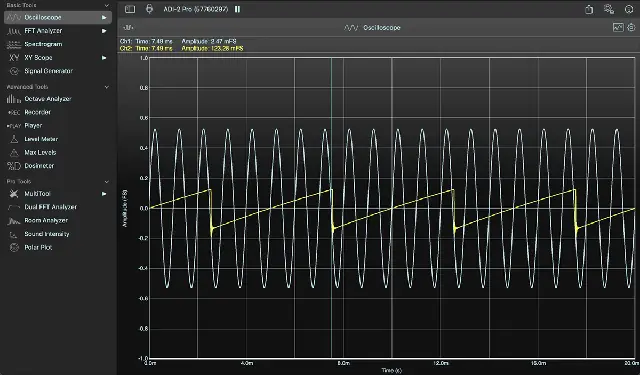
SignalScope XM Basic Tool Set equips you with five fundamental instruments for signal analysis. The oscilloscope displays time-domain waveforms, while the FFT analyzer reveals frequency content. A 2D spectrogram offers a time-frequency view, and an XY scope visualizes Lissajous patterns for phase comparisons. A stereo signal generator provides test tones for stimulus-response experiments.
These tools accept input from any audio device connected to your Mac. You can assign engineering units to input signals and calibrate external transducers, making raw voltages meaningful for acoustics. For USB microphones with built-in sensitivity data, SignalScope automatically loads calibration, simplifying accurate sound pressure level measurements. Manual switching between audio input and output sources is supported.
Calibration and Hardware Support
Accurate measurements require proper calibration. SignalScope XM allows you to assign units and sensitivities for individual USB audio devices. For select USB microphones, factory-supplied microphone sensitivities are auto-loaded. Updated nominal voltage sensitivities are provided for certain audio inputs. Automatic calibration works when the input device includes built-in sensitivity information, reducing setup time.
The app offers enhanced support for hardware from manufacturers like Digiducer, The Modal Shop, Dayton Audio, and miniDSP. This includes connecting lab-grade microphones and sensors via suitable interfaces. For frequency-dependent responses, you can load microphone frequency response data (FRD) files and apply frequency response correction (FRC) to FFT-based measurements, improving accuracy across the spectrum.
Data Management and Export
Captured measurement data can be saved for later analysis or reporting. The app supports exporting data to CSV, tab-delimited ASCII text, or MAT files, giving you flexibility in how you process results. High-resolution analyzer display images can be saved as PDF files, which is useful for documentation or presentations.
Sample rates are manually adjustable, and depending on your input hardware, rates up to 768 kHz are possible. This high-rate capability is valuable for analyzing ultrasonic signals or high-frequency transients. However, actual rates depend on the capabilities of your audio interface. The export options ensure data remains portable for external tools like spreadsheets or numerical computing environments.
Practical Applications and Workflow
Typical workflows begin by connecting a microphone or sensor, selecting it as the input source, and setting appropriate sample rate. After calibration, you can use the signal generator to produce a known stimulus and analyze the response with the FFT analyzer or oscilloscope. The spectrogram helps track changes over time, such as resonances or noise.
This tool set is suited for electroacoustic testing, room acoustics checks, and product development. For example, you can measure speaker frequency response or verify transducer performance. While basic, the included instruments cover many everyday measurement tasks, and the calibration features ensure reliable results. The app is designed exclusively for Mac users.
Key features
- Includes oscilloscope, FFT analyzer, 2D spectrogram, XY scope, and stereo signal generator
- Assign engineering units and calibrate external transducers
- Auto-loads sensitivities for select USB microphones and input devices
- Loads microphone frequency response data (FRD) for correction
- Manual switching between audio inputs and outputs
- Exports data to CSV, TAB, or MAT files; saves images to PDF
Best for
This Basic Tool Set is ideal for acousticians, engineers, or students who need straightforward signal analysis and measurement on a Mac, especially when working with supported USB microphones or lab-grade sensors for frequency response, phase, and noise measurements.