Korneff Audio AIP Amplified Instrument Processor — Free Download
AIP is a comprehensive channel strip for sculpting guitar, bass, keyboard, vocals, and full mixes, featuring multi-band EQ, dual compressors, filtering, and stereo widening in one interface.
Purpose and Core Design
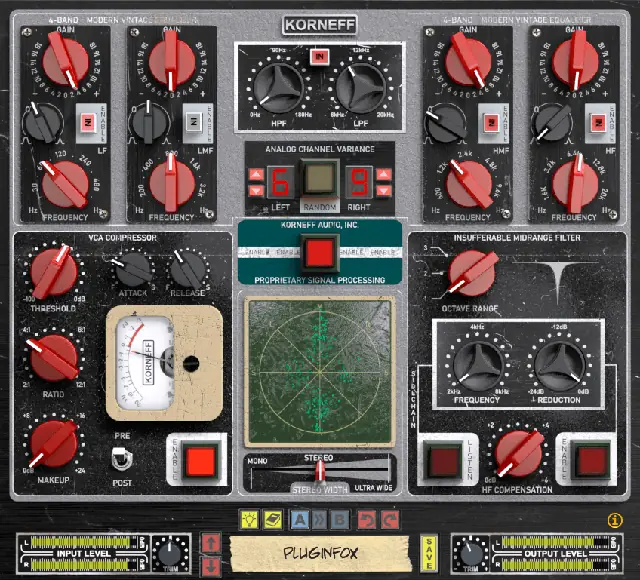
The Amplified Instrument Processor is a versatile channel strip designed primarily for electric guitar, bass, and keyboards, but its flexible toolset makes it suitable for vocals, acoustic instruments, piano, group buses, and even the entire mix. It combines four bands of parametric EQ, two distinct compressor types, filtering tools, and stereo enhancement in a single processor, allowing users to shape tone without chaining multiple plugins.
The EQ is modeled on mid-century German tube equalizers, offering digital precision with analog character. Users can switch between active and passive response curves, adjust circuit-age modeling to simulate component aging, and choose from multiple channel variations to reflect the slight inconsistencies of vintage handmade units. This design encourages experimentation, balancing modern control with unpredictability.
Equalization and Signal Processing
The parametric EQ provides substantial boost and cut with gain scaling, plus independently switchable high-pass and low-pass filters. The switchable response types let users set a modern active curve for cleanliness or a vintage passive curve for coloration. Circuit-age and channel variance features introduce subtle analog anomalies, adding depth and individuality to the sound.
Proprietary signal processing offers three response models: tube for warm, round tones on bass or male vocals; tape for low-end push and high-end sparkle on heavy guitars or drums; and solid-state for a mid-forward sound reminiscent of classic consoles, making elements sit upfront in the mix. A slew rate adjustment further shapes transient response to match different source materials.
Compression and Filtering
The VCA compressor, modeled on a classic integrated circuit, provides full control of threshold, ratio, attack, release, and makeup gain. It can be placed before or after the EQ to tailor the response, and a nulling control lets users adjust the amount of color when the compressor is driven hard. This makes it equally effective on guitars and vocals, delivering smooth, musical gain reduction.
A second compressor focuses on frequencies below a set cutoff to control the low end—tightening chugging guitars, taming resonant bass, reducing vocal chestiness, or removing kick drum ring. Additionally, a dedicated notch filter targets the presence range to reduce harshness from overdubs, guitar whistles, sibilance, cymbal hash, and finger noise on acoustic instruments.
Stereo and Visualization
The stereo widening algorithm spreads audio across the sound stage while preserving center image solidity. This is ideal for wrapping reverb around listeners, enhancing the movement of keyboard pads, and placing dual guitar parts at opposite sides. The processor ensures width enhancement does not compromise mono compatibility or the anchor of central elements.
A real-time analyzer displays the frequency response of the input signal and overlays EQ curves and frequency-dependent gain reduction settings. This visual feedback helps fine-tune adjustments quickly, ensuring that cuts and boosts align with the source material’s spectrum. It simplifies the workflow, especially when managing complex processing chains.
Key features
- Four-band parametric EQ with switchable active or passive response curves
- Circuit age modeling and multiple channel variance options for analog character
- Proprietary response models: tube, tape, and solid-state with slew rate control
- VCA compressor with full parameter control and pre/post EQ placement
- Frequency-dependent compressor for low-end management below the cutoff point
- Specialized notch filter for presence range issues and a stereo widening algorithm
Best for
Best for producers and engineers seeking an all-in-one tone-shaping tool for guitar, bass, and synths, but also effective for vocals, drums, and full mix processing. Its combination of EQ, dual compressors, and stereo tools simplifies complex routing, making it ideal for both mixing and sound design workflows.